
Kenosha Criminal Court Records
Kenosha Criminal Court Records usually start with WCCA, then move to the Kenosha County Clerk of Circuit Court when you need the local file, a copy, or a clearer answer about the case. That is the practical route because city cases that involve felony or misdemeanor charges usually sit in county circuit court, while municipal courts handle traffic, parking, ordinance issues, and some first-offense OWI matters. If you know the party name, case number, or filing year, you can get a usable first result quickly. From there, the county clerk and the county law resources help you separate a city matter from a circuit-level criminal case.
The county image below comes from the Wisconsin State Law Library's Kenosha County - Wisconsin State Law Library Kenosha County page.
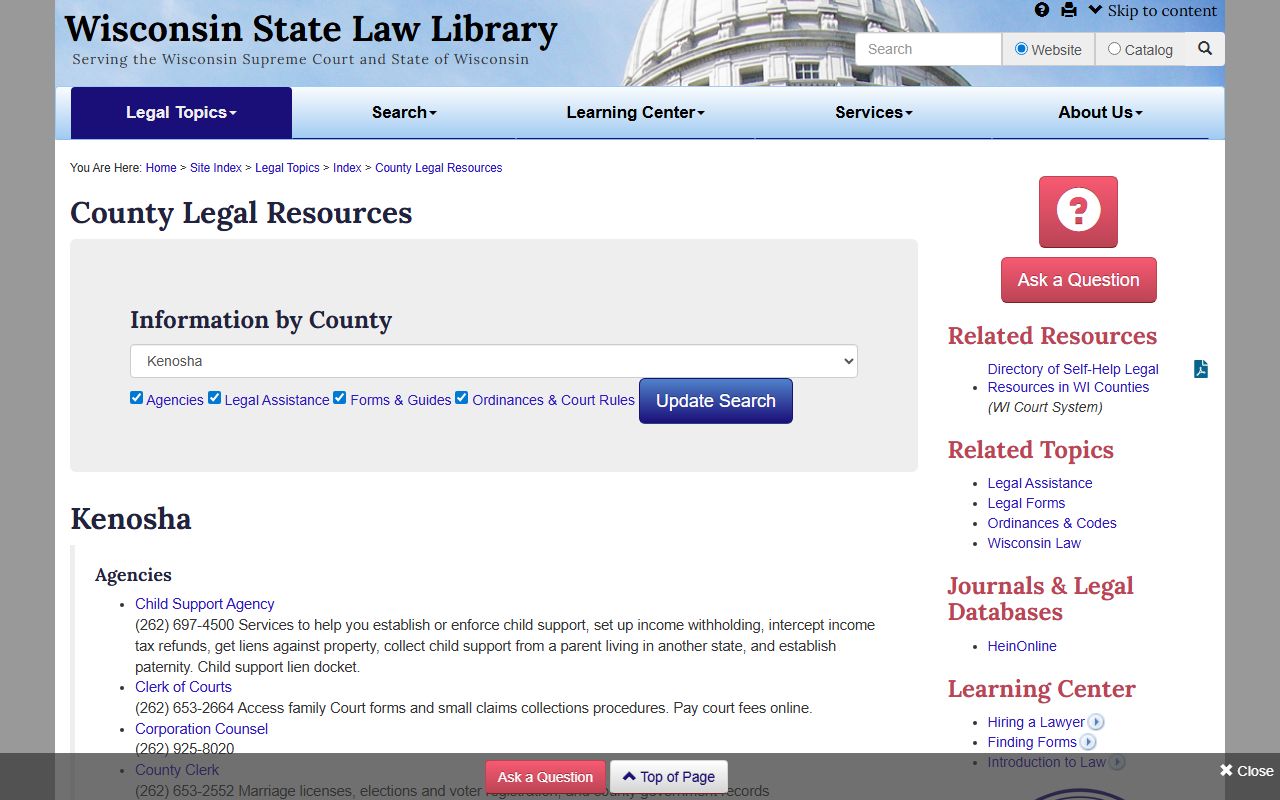
This image gives Kenosha Criminal Court Records a local anchor and points back to the county's official court network.
Kenosha Criminal Court Records Online
The Wisconsin Circuit Court Access portal is the public first stop for Kenosha searches. It includes circuit court records, filed documents, municipal court records, criminal court records, and recorded liens. WCCA has been online since April 1999 and updates case information hourly unless the site is under maintenance. The nightly maintenance window can run from 3:00 a.m. to 4:00 a.m. Central Time. If a result is missing during that window, it may simply be waiting on the next refresh.
WCCA gives you several ways to search. You can look by name, by case number, or by more detailed fields in advanced search. Judgment search helps when a criminal matter has a lien or money judgment tied to it. That matters because WCCA is not the official judgment and lien docket, even though it reflects the information entered into the circuit court case management system. For Kenosha Criminal Court Records, that makes the portal a strong public guide, not the final copy source.
The portal also excludes records that are not open to public inspection. Adoptions, juvenile delinquency, child protection, termination of parental rights, guardianship, and civil commitments do not appear. That boundary keeps the search focused on open criminal and circuit court material while protecting files the court keeps closed.
That split matters in a city like Kenosha because the municipal court and the circuit court do different jobs. Municipal cases often cover traffic, parking, and ordinance matters. Circuit cases cover criminal files that can involve felony and misdemeanor charges. WCCA helps you tell the difference before you start calling offices.
Kenosha Criminal Court Records Clerk
The Kenosha County Clerk of Circuit Court is the office that keeps the county's written court record in order. The state clerk directory places the office at 912 56th St, Kenosha, WI 53140-3736, and the phone number is (262) 653-2664. The county law library page lists Kenosha County court resources, including the county clerk, sheriff, district attorney, and treatment courts and criminal justice programs. That gives you a practical local map before you start asking for records.
The law library page is useful because it shows that Kenosha residents can be routed through county criminal justice programs as well as the clerk's office. Those programs do not replace the court file, but they can affect where a case goes after the first filing. If you need a certified copy, a docket clarification, or a record request, the clerk remains the first office to contact.
As in other Wisconsin counties, the clerk office is the best place to start when you need the official file rather than a guess from memory. The contact directory and law library page together give you the county address, the working phone number, and the public record path without making the search more complicated than it needs to be.
Kenosha Criminal Court Records and Municipal Courts
City residents often run into the municipal court first, but that court is not the same as the county circuit court. Wisconsin municipal courts commonly handle traffic, parking, ordinance matters, and some first-offense OWI cases. The statewide municipal court overview explains that municipal courts are governed by Wis. Stat. chs. 800 and 755. As of January 2025, Wisconsin had 219 municipal courts and 222 judges, and statewide municipal courts handled more than 425,000 cases in 2023. Milwaukee has the largest municipal court, with three full-time judges, which shows how big the municipal system can be even before you reach circuit court.
For Kenosha, that means a city-level case may start in municipal court but a criminal case moves through the county clerk. The public record path depends on what kind of case it is. If the matter is a city ordinance issue, the municipal court overview is the better guide. If it is a felony, misdemeanor, or criminal traffic case, WCCA and the circuit clerk remain the right search path. The key is not to mix those two systems together.
The legal distinction is useful because a city search often needs both sets of contacts. You may need the municipal court for a local ordinance case and the county clerk for the circuit-court record. That is normal in Wisconsin. It is not a problem. It just means the search should follow the case type, not the city name alone.
Kenosha Criminal Court Records Search
Kenosha Criminal Court Records searches work best when you keep the record type in mind. A municipal traffic matter belongs with the municipal court. A felony or misdemeanor criminal case belongs with the county circuit clerk. If you start with a full name, a filing year, or a case number, WCCA can narrow the field and show you which office should answer the next question. That is the easiest way to keep the search from drifting.
The county law library page also points to treatment courts and criminal justice programs. That matters because a case can move through a problem-solving track after filing. Those programs do not replace the docket, but they can explain why the case history looks more involved than a simple online lookup. The clerk still remains the best source for the actual file.
For broader statewide history checks, Wisconsin's WORCS system is the official public adult criminal history search. It is not the same as a court file, but it can help when you need a background summary while the clerk handles the actual case paperwork. That split matters because criminal court records and criminal history summaries answer different questions.
Kenosha Criminal Court Records Requests
When you need more than WCCA, the clerk office is the place that turns a screen result into a record request. That matters for older files, certified copies, and cases that do not show enough detail online. The county clerk's office also helps keep the public record trail organized, which is why the clerk contact page is so useful when you need the official office location and a working phone number.
If you are checking access rules rather than legal theory, the Wisconsin statutes on public records and clerk duties are useful reference points. Wis. Stat. § 19.31 explains the public policy behind access to records, and Wis. Stat. § 59.40 describes the clerk's role in the circuit court system. For the criminal-history side, Wis. Stat. § 165.83 and Wis. Stat. § 165.84 explain how state criminal-history data is maintained and supported.
Those tools do not replace the local file. They just show how the state and county pieces fit together. When you want the actual criminal case record, the clerk remains the first office to call and the most direct way to confirm the next step.