
Find Oneida County Criminal Court Records
Oneida County criminal court records are useful when you need a docket note, a hearing date, or the case file that sits behind the public summary. WCCA gives you the quick public view, and the clerk of court keeps the official file in the county. Oneida County also has a district attorney office, a sheriff department, and court offices that help explain what happened after a charge was filed. If you only have a name or an old offense type, the county record trail can still narrow the search and point you to the right branch court and the right office to call.
Oneida County Overview
Oneida County Criminal Court Records Online
The main online place to begin is Wisconsin Circuit Court Access. WCCA is the statewide portal for circuit court records, filed documents, municipal court records, criminal court records, and recorded liens. It has been online since April 1999, and the site uploads new case data hourly unless maintenance or a technical issue interrupts the cycle. The portal may also be down each night from 3:00 a.m. to 4:00 a.m. Central Time. That makes WCCA a strong first stop when you want to check a new filing before you call the courthouse.
WCCA supports searches by name, case number, and more advanced fields. It also has a judgment search for liens and money judgments. That can help when a criminal case connects to a financial order or an older docket note. Some records do not appear on the public site at all. Wisconsin open records policy in Wis. Stat. § 19.31 supports access, but it still leaves some records off the screen. If the public summary is too thin, the clerk office is the place to go next.
Oneida County Criminal Court Records Clerk
The clerk of court is the main local office for Oneida County criminal court records. The county law library page at Oneida County legal resources lists the clerk at (715) 369-6120, the county clerk at (715) 369-6125, the district attorney at (715) 369-6133, the family court commissioner at (715) 369-6152, the register in probate at (715) 369-6159, and the sheriff at (715) 361-5100. That page is a clean directory when you need to move from an online docket to a real office contact.
The state clerk directory lists the office at 1 S Oneida Ave, PO Box 400, Rhinelander, WI 54501-0400. That is the office to contact when you need copies, docket details, or help sorting an older criminal file. Because the clerk handles the official record set, it is also the best place for questions about what WCCA shows and what it leaves out. Oneida County’s branch court setup can make a search feel spread out, but the clerk remains the main records point.
The Wisconsin Court System directory points back to the clerk as the primary contact for circuit court records and case information. That matters when a search turns on the record itself rather than on a legal question. In Oneida County, the clerk office is the place that can confirm whether a file is active, archived, or ready for a request. That makes the first call simple and keeps the search tied to the county record trail.
Oneida County Criminal Court Records Image
The image below comes from the Oneida County Wisconsin State Law Library page and gives a local visual reference for Oneida County criminal court records research.
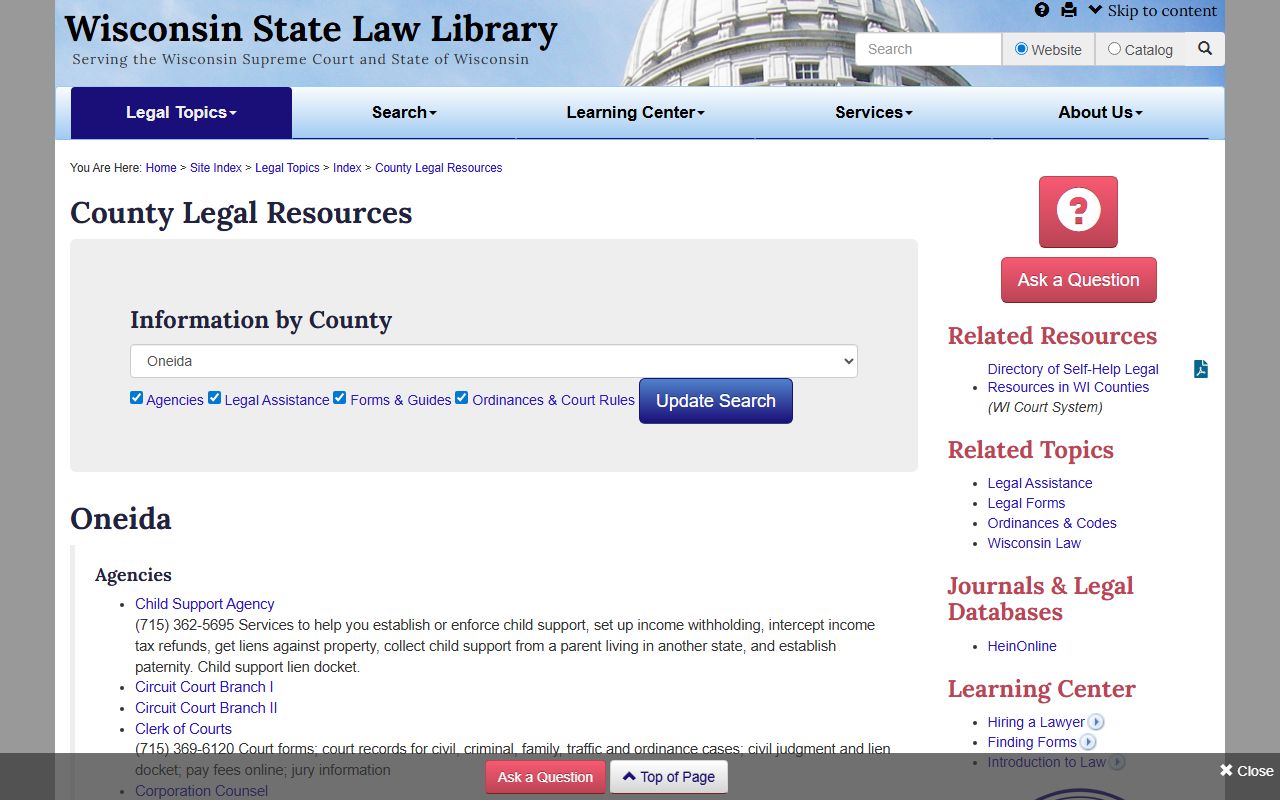
That county source keeps the search tied to the clerk, sheriff, district attorney, and family court commissioner. When WCCA only shows a short summary, those local contacts help you move toward the full record.
Oneida County Criminal Court Records Agencies
The sheriff department is a key part of Oneida County criminal court records because it handles county law enforcement, jail activity, and criminal warrants. The county law library page lists the sheriff at (715) 361-5100. That matters when the case involves custody, a transport, or a service issue that the docket only hints at. The district attorney office is the prosecution side of the same trail, and it can help you understand whether a charge is active, amended, or resolved. Those offices give context that the online docket cannot always show.
Oneida County also has branch courts, which means the criminal case may not read like a simple one-room system. The record can still be searched, but the office path may matter more than the branch label. The family court commissioner and register in probate are part of the wider courthouse picture, especially when a criminal matter touches a family or probate issue. Even then, the criminal record still begins with the clerk and the public WCCA summary. That is the safest way to keep the search organized.
For a statewide adult criminal history check, the Wisconsin Department of Justice offers the Wisconsin Online Record Check System. The DOJ describes the state CHRI repository and the fingerprint-based record process in Wis. Stat. § 165.83 and Wis. Stat. § 165.84. That statewide check is not the courthouse file, but it can confirm whether a Oneida County record also appears in the state system.
Oneida County Criminal Court Records Search Tips
Start with the strongest clue you have. A full name, a rough year, or a case number is usually enough to get WCCA moving. If the result is short or unclear, the clerk office can help you decide whether you need a docket printout, a copy, or a file room search. That is especially useful in a county where branch court references can make the record path look more spread out than it really is. The county law library directory is a quick way to keep the right offices lined up.
Older records may show less detail online. WCCA is public and fast, but it does not hold every possible document in full image form. Some older Oneida County records may sit in paper or scanned files that are still official even if the portal gives only a summary. That is where the clerk office earns its place in the search. It can tell you whether the file is there, whether a copy can be requested, and whether another office needs to answer the next question.
If you are comparing the county docket with the state history side, the DOJ record check can be the bridge between the two. It is not a substitute for the court file, but it can help confirm whether the county case is reflected in the statewide criminal history repository. That is often enough to decide whether you need to stay online or move straight to the courthouse.